Wednesday, July 27, 2016

Driving Through the Burned Area along 189/191, The Cliff Creek Fire

We have been closely watching the Cliff Creek Fire. It’s a fire that has grown to almost fifteen thousand aces, which is about twenty-five square miles of burned area. The fire is east of us and poses no threat but the fire area is not far from where our son and his wife live. They also have not been in danger and the smoke hasn’t been bad there but worrying goes with being parents.
So when the highway reopened we decided to drive through the burned areas. On the way we were treated to the sight of a nanny mountain goat and her kid but they disappeared into trees before we could take any images. As we approached Hoback Junction, the smoke increased and we could see it was thicker as you went traveled along the Hoback River.
Heading up the Hoback Valley we drove past a camp of firefighters. It was early and they were gathered in circles, engaged in a morning meeting/gathering. Periodically fire trucks were parked at strategic places as all eyes were concentrated on monitoring the fire and protecting any structures.
We didn’t encounter any burned areas until we were well up the canyon and then we passed through typical fire patterns. Forest fires don’t burn everything and so interspersed with burned ground, and areas where the fire crowned out were areas of green where the fire bypassed small groups of trees.
There were areas where the fire had only left pillars of tree trunks and areas where even these had burned, the hottest areas of fire. While we didn’t see any of these I did take classes on fire ecology and I had actually seen where large sheets of granite had exploded off of massive outcrops. Such an explosion is caused when the intense heat turns trapped water into steam. You literally see sheets of rock laying on top of ash.
Nearing the town of Bondurant we saw where the firemen/women had made stands and saved buildings along the river valley. Many were Federal Hotshot fire crews from all over the West.  Just south of the town a heliport had been set up where helicopters were based while fighting the fire.
Driving by them we spotted a huge badger poking his nose out of the ditch but again we couldn’t get any images before he moved back into the sagebrush. His claws were huge and reminded me of ones we had seen on grizzly bears in Alaska, seriously!
We did see some of the fire itself in burning areas away from the road. You could also see a line of current fires burning towards the Gros Ventre, (pronounced grow vont), Mountains. The plan now is to let the fire burn itself out, (when the snows fall), and to contain the fire by back burning. That is a process where fires are deliberately set, when the winds are favorable, to take fuel away the active fire.
As I look at the burned areas I think of how the newly burned area will bloom with life. Such burned areas are a far cry from the sterile forest floor under a mature forest canopy. This area was well past maturity and many of the trees had died from the pine beetle infestation. The same thing happened when Yellowstone burned in the fires of 1988 and the herds of grazers increased, (elk, deer and buffalo).

Clear skies

Wednesday, July 20, 2016

A Day with Friends at Greys Lake Refuge

Bob and Nancy visited us last week and of course I told them of all the fish we were catching. We spent a day on the Little Grey and then a day on Salt Creek and you can probably figure out what happened. The water had dropped at both streams and the fishing was nonexistent. Still we had nice picnics and of course the scenery was beautiful, but no fish. So on their last day we decided to take a break from fishing and go birding at the Greys Lake Refuge. Surely the birds would cooperate.
Arriving at the refuge headquarters Renita first spotted a family of sandhill cranes. The day was already a success! A little further down the road Nancy spotted a pair really close to the road and so we tried to take some images as they walked through the thick grass and reeds.
Further on we stopped to watch a turkey vulture sitting on a fence post. A flock of mountain bluebirds put in an appearance and the day became a day of relaxing bird watching. Stopping at some open water we pointed out yellowheaded blackbirds and to add to the stop, three white faced ibis flew overhead. The breeding colored iridescence had faded from their wings but no matter it was a nice trio of close flying birds.
We really spotted quite a few sandhills, many more then we saw during our last trip. Stopping along the road we showed them the volcanic rock that dominates the landscape. Some was hardened pyroclastic breccia which told of nuee-ardente, Its  the most dangerous type of lava that flows down the volcano's sides at several hundred miles per hour.

In places the basaltic lava flows were full of vesicules, bubbles that formed when the molten lava out gassed much like a shaken can of pop. However the lava had cooled so quickly that the bubbles were trapped, forever frozen in the stone.
Leaving the refuge we returned along Tin Cup Creek and found a nice place to stop for a picnic. As we ate a sheep herder drove his flock on the road near us and in the flock was a single black lamb. Renita and Nancy ended up taking way to many images of the sheep drive, but that's what the new cameras are for, taking lots of very inexpensive images.
So we had a nice day of birding and after the necessary hugs and goodbyes waved them adieu promising to see them again, down the road, Of course we went fishing the next day and Renita and I both caught beautiful cutthroats, but that's the way fishing goes. Clear skies.

Tuesday, July 12, 2016

We celebrated the fourth by walking outside and watching the fireworks. There was really nothing nearby but looking across the Lower Valley we could see occasional bursts. There seemed to be two main areas, one was near Thayne and the other along the Salt River. No fireworks were allowed in the resort as the threat of fire is always present.
Two days later found us floating the Salt River, from the Creamery to a landing point called the Swimming Pool. George, Val’s husband, had agreed to take the truck to the take out point and so we pushed off into a fast current. In no time at all Val was around the first meander and Renita followed closely behind her.
I could tell Renita has learned a lot about floating the river as she chose the quieter channel, easily avoiding the one hazard. Val had hit the low branches one time and dumped her kayak but both women easily passed the test.
Meanwhile I was attempting to fish the fast moving stream using two nymphs with a small split shot and a strike indicator. I had tied on the new flies, a pheasant hair nymph and a very small nymph called an emerger. On the first cast I watched the indicator move sideways and was fast onto a really nice fish.
As I fought the fish the current kept sweeping my kayak downstream and between the fish pulling in one direction and the yak in another the hook pulled out. Another cast and the same result before I caught a small mountain whitefish.
Around the next bend another good looking spot presented itself and on the first cast I snagged and broke off both flies. Fifteen minutes later I caught up with the two speeding girls, they had pulled over and waited as I had retied two new flies.
Two more casts and I broke off the new flies and so I switched to a dry, a purple haze with a small emerger as a dropper. Nothing took my flies even though I made some casts to rising fish. Meanwhile the current was taking me rapidly sideways and I soon swept into a submerged log. I was lucky I didn’t dump the boat!
Snagging the flies I lost two more and then high centered on another snag. Deciding this simply wasn’t working, I resigned myself to enjoying the float and placed my fly rod aside for the rest of the float. After about two hours we reached George at the first take out point and after a brief chat we pushed off to finish the float.
The river was moving so fast that we reached the Swimming Pool in about twenty minutes, (it has taken us forty minutes on previous floats, because we seldom are in a hurry). It had been a nice day and a nice float. It had also shown the promise of the new flies I had purchased along with the folly of trying to fish while floating a fast moving river.

On the way home we talked of the great float and the promise of more floats to come. I also decided I need a shorter kayak as my twelve footer is just to long for the fast current and sharp bends of the Salt River. Clear skies

Saturday, July 9, 2016

Fine Spotted Snake River Cuththroats

I cast the royal wolf to an eddy . The snow had melted and the water had finally cleared. The dry fly floated past the eddy and almost reached the end of the run when I saw the fish rise up and take my offering. Setting the hook I saw the flash and knew that I had another fish on!
It had been a typical June with high and muddy waters and this was only the second time out. The Greys River was our first choice but as soon as we saw the milky water we knew we had to try a smaller stream with clearer water.
We had already fished Salt Creek and Val and George had also fished Fall Creek. Salt had been a great bite on nymphs and they had told us that Fall Creek was full of small but fun cuts. Now we all had put on our favorite fly, George of course was using a nymph and Val had selected a lime trude.
They had headed upstream, while I headed down and I knew that they had to be on fish.
I caught the small but feisty fish and using the forceps unhooked and released it back into its home. It seems a shame to kill such a beautiful wild and native fish, (although I love eating fish), and making another cast to the same run another cut rose to my offering. I ended up catching and releasing four fish from the same stretch, before heading further down the river.
Picking up a fish hear and there I noticed some movement on the other bank and stood still as a raccoon walked along the shore hoping to find something good for lunch. I was sure it would love a fresh trout but there was no way I would offer it one as I refuse to feed wild animals, ( a fed bear is a dead bear and it just doesn't refer to bears).
Heading down the canyon the walls closed in and I realized I would have to scramble quite a ways before I could cross the stream and make the steep climb to the road. Of course I rolled my ankle when I forded the creek but it wasn't as bad as iI feared and so I labored up the series of switchbacks until I stood on top.
Chastising myself for putting myself in such a predicament I still had caught and released ten fish and so I felt pretty good as I hiked back to the car looking for my friends. Reaching George I saw him in the act of releasing a fish and he told of how the fish had been inhaling his nymphs..
A little further I tried my favorite hole and four more cuts chewed up my fly. Seeing Val I watched as she retied a new fly and she told me of fish after fish. She said that the fish had destroyed her trude and how she had lost track of the number of fish she had caught!
Passing round her, I continued to catch fish on my same royal wolf until I too lost count somewhere in the twenties. For every fish I did succeed in landing and releasing I had lost or missed three more. It was one of those days where nothing seemed to go wrong. I tired to think of other fishing trips and the only one that bested this day was the opening day on the Yellowstone River.
That was way back in 1974, when Renita and I had retraced my summer geology field camp experiences from the year before. At that time I was still in school not knowing that the trip to Wyoming was a precursor to us moving there.
Meeting back at the car we talked of the great day! We had caught and successfully released over seventy five fish. Eating our lunch we decided to call it a day as we were all tired from climbing the steep banks. Whats really funny about it all is that we had not seen another fisherman! Clear skies

Monday, July 4, 2016

Greys Lake National Wildlife Refuge, 2016

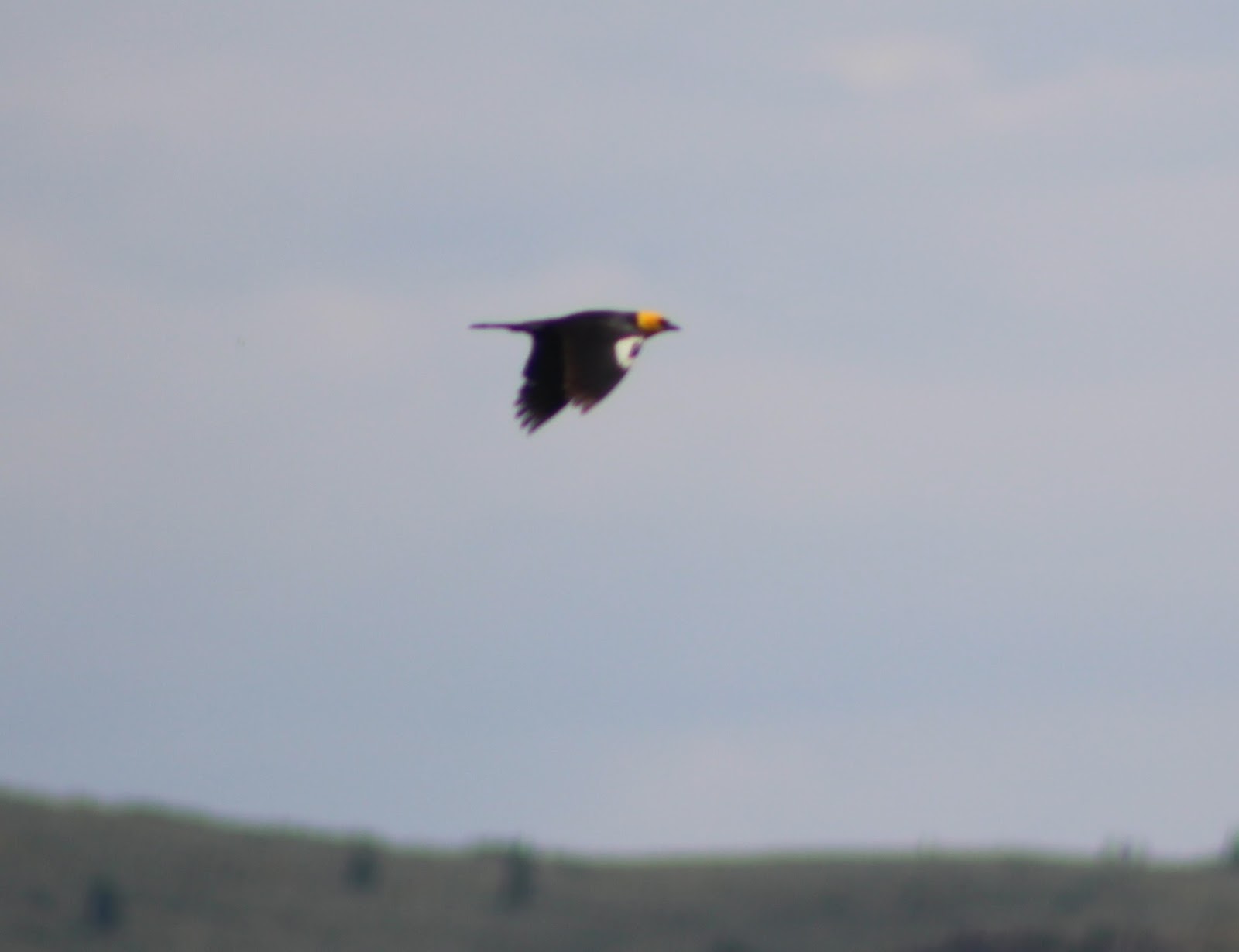
It wasn't really any surprise when we looked up which president had founded the first wildlife refuge. Theodore Roosevelt, by executive order established the first refuge in Florida in 1903. This was Pelican Island National Wildlife Refuge along central Florida's Atlantic Coast. As if to celebrate this a male yellow headed blackbird posed atop the Grey Lake National Wildlife Refuge sign, showing us its breakfast of fresh caught dragonfly.
We had hoped to visit the refuge earlier this year in an attempt to catch the birds at the height of their spring colors. Luckily their plumage still showed some of the colorful spring garb although we saw many chicks in a dull brown and grey. To compound our birding the reeds and tulle's had grown tall and so the birds flitted in and out as we concentrated on flying images, ( if you have a camera that takes sport photos you have to switch it to that mode and then try taking images of birds in flight)!
The two birds that dominated the day were the yellow headed blackbirds and the white faced ibis. We were very happy with quite a few of the images. We took over two hundred total, not a really large number for us and thank goodness for digital photography.
We also spotted an immature red tail hawk. It was losing its first plumage and while the red tail hadn't fully developed you could see the promise of its adult color.  Its probably one of the best images we have ever taken of a hawk and definitely the best in flight!
We did see more sand hill cranes, one was a family of two adults and three chicks. They were feeding in the same location as where we had imaged a family group in last years visit. After leaving the image we did a short side trip to check out the Gravel Creek Campground. The mosquitoes were in full attack mode, it has been a banner year for them, and so we ate lunch inside the truck.
It had been a great trip to the Greys Lake National Wildlife Refuge. Thank goodness fro the great leaders our country has usually elected. Presidents who actually cared for the common good. Presidents like Theodore Roosevelt! Clear skies

Wednesday, June 29, 2016

Alpine Mountain Days 2016

We only participate in six shows a years and so when the Alpine Mountain Days Show comes around we try to be extra prepared. It’s the biggest show we sell at and while not juried it does draw a large crowd. This year’s crowd mix of locals and tourists was the largest the show has ever attracted.
The setup was on Thursday and of course it took us several tries to get the side curtains on right. We only use the canopy tent for two shows a year so it’s no surprise we have a little confusion. We were in the same spot as the last two years adjacent to the food venders.
On Friday the show started at noon and not a lot happened as Fridays show is usually a pretty slow day. Still people stopped by and many said they would come back which usually means you will never see them again. We did have a few sales and we did have a good start for the first day.
Saturday morning arrived and it didn’t take long before the crowd grew. Friends stopped by to ask us to identify their rocks and collections, and we always welcome that as it lets us meet local rock hounds and see what local rocks are waiting to be found.
One person brought us a doorstop that his mother had found in Minnesota. It was about a five-pound piece of a reddish amber and we both drooled at its beauty. Another showed us her agate collection. but this time they were all locally collected, and a young lady proudly showed us the river rocks she had painstakingly pried from the local river gravels!
Tourists from China pointed at our labeled jade as I had looked up the Chinese symbols for jade and added it to the case. One Chinese tourist showed me pictures of his rock collection and even though we couldn’t understand a word we both said we both understood each other’s love of agates.
The sales were steady but not record breaking and that’s what happens at our shows. Our pendants, rings, bracelets and fossils were the most expensive items for sale in their categories and you really need the right people to stop by.
We aren’t just selling jewelry we are selling stories and we can tell the story of each stone. I was a geology instructor for thirty years and Renita worked at a coal mine so we have fifty-five years in the rock business. We have also been collecting, working stone and making jewelry for the past eight years and so we have lots of stories to tell, (too often the other venders have no idea of the name of the rock they are selling).
Sunday morning was another perfect day with the temperatures in the seventies and little wind. Not much happened at first but by noon the crowd arrived and we were busy for most of the afternoon. The show finally closed and Renita continued selling as I packed everything up.
It had been a great show and not just in sales. More important to us we had met many new people who also had a love of rock hounding and their passion and stories inspired us. We are collectors first and love what we do. When you retire be sure to find a new passion or continue a life-long one, if you do you will never grow bored and you will find out that the days are two short! Clear skies

Tuesday, June 21, 2016

Fishing Salt Creek, Bonneville Cut Throats and Mountain Whitefish

We have been very busy getting ready fro our summer show season. So its been a while since I last wrote an entry. I have been concentrating learning how to work opals, Koroit Boulder Opals and Opalized Canadian Ammolites. Renita has been making her kumihimo braided necklaces and we both will be ready for our biggest show of the year.
So when George and Val returned from their Colorado hay ranch, ( George is 82 and Val 69 and they had both been bucking bails from their first hay cutting), they asked us to join them and go fly fishing. I hesitated a bit but luckily agreed. The rivers had been muddy but the small Salt Creek had cleared a bit and was fishable.
Packing a lunch we headed over the pass stopping at our favorite walk in spot. The land here is private but Wyoming Game and fish has an agreement that allows fisher people access to the stream. As we set up I asked George and Val what they were going to use and of course George was going to opt for nymphs while Val was going to start with her dries. I decided to put on a dry, an orange stimulator with a dropper fly.
With high hopes I hurried to my favorite spot and made repeated casts but all to no avail. I next tried a parachute dry and then a royal wolf but again I didn't have any takers. I looked back and saw George set the hook on a nice fish and so I changed to nymphs.
As I cast along an undercut bank I missed two fish. It usually takes mne a while to set the hook properly and so I started zero fro two. seeing some fish rising to a hatch I changed back to a parachute and missed a nice rise before setting the hook on a small but feisty cut throat.
A little further up stream I had a nice fish take an elk caddis and gently fought the fish in before releasing it back to its home. I didn't have any more takers and so I returned to the truck where Renita was setting out our lunch. She wasn't fishing as she is taking a strong medicine and cant do anything strenuous so she had actually brought her kumihimo.
George and Val had beaten me to the car and George was all smiles as he told me he had caught and released fifteen fish. Val had been blanked on her dries and the trash talking was on as George told us we need to change to wet flies, (wet flies sink and so you have to use a strike indicator to see when you have a bite.
After lunch we headed back to the stream and I watched George catch three fish in a row. I knew of a hole downstream and so I headed there. On my first cast the line reached an eddy and my strike indicator disappeared. Setting the hook I fought in a nice mountain whitefish. Now I don't care what I catch and so after releasing the fish I cast again and had another whitefish. I made eight casts and had eight bites in a row.
Meanwhile George had caught and release his own whitefish! We fished a bit more before deciding it was time to head back to the Ranch. We had caught and safely released eighteen fish. It was a great start to the season and a great break from grinding rocks, (although I enjoy working stones). Thank you George and Val!

In a sad note tourists speeding though Grand Teton National Park killed two bears yesterday. One was a female black bear and the other was a new grizzly cub, the son of one of the most famous bears, grizzly 399. The last anyone saw was the sow dragging her dead cub into the woods. Oh and the tourists didn't even stop.

Slow down idiots!