We got up early, five am, and headed back to the Daysville road. There we wanted to watch the bears and maybe even fish a little. Our main hope was to see the momma grizzly and her cubs but they never showed up. Instead we stopped for a bit and watched a pod of seals swimming toward the salmon at Solomons Gulch.
As we stood taking images an otter swam to shore and ran across the road disappearing into the thick brush. We wondered if it had a den. It sure had a purpose and it sure made a beeline. I took my pole out and cast into the schools of fish, hoping to catch a silver.
Before the single hook Mepps spinner even settled to the bottom I had a fish on. It was a foul hooked pink and it came off. Casting again I lost three fish before I got my lure back and each cast produced a fish. I eventually caught two fish for pictures, a male and female humpy,(pink salmon).
They weren't biting and all the fish were snagged in the dorsal fin so I released both fish. I wasn't setting the hook and still there were so many fish I couldn't not hook a fish. Stopping fishing we watched a bit and then headed back to the bears.
A black bear was feeding at the same place as yesterday and we watched it catch another salmon before it drug it into the thick brush. Waiting a bit a second bear appeared behind us and proceeded to catch and eat a dozen salmon.
The bear had a lot better catching rate then I had. Perhaps if I had used my teeth and I should have been dunking for salmon like the bear. It only ate the salmon eggs and left the rest of the carcass on shore. The bear sniffed a bit and then headed nearer us and soon we saw why as a larger black bear appeared and started fishing.
There were so many fish that both seemed content, at least for a while and I was reminded a bit of the combat fishing on the Kenai. Soon however the larger bear stood up and the smaller black hurried off into the woods. We had seen them catch and feed on at least thirty salmon in less then fifteen minutes.
Reluctantly we drove off and headed in search of more bears but we didn't see any more, just lots of bald eagles and gulls. Later in the day we took a short drive to the Mineral Creek Trail and hiked a bit, even though we could have drove in as we were soon passed by several trucks.
It was a nice hike and we did pick some blueberries, they weren't yet sweet, and passed a thicket of salmon berries that something had been feeding on,(hmm are those bear tracks?). Now one of the things while hiking here is to talk so that the bears will have a warning of your approach and its so weird to make noise as I have always been taught to be quiet.
We never did see any bears and so we returned to the truck and made one last stop for the day, at the cannery area on the harbor. There the Peter Pan Cannery had a processing plant and even a dormitory for workers.
Stopping at the retail store we picked up some cans of Copper River Red salmon and some frozen razor clams. As dinner was now assured we headed home to clean up and prepare for the trip to Tok.
Valdez had turned out to be as beautiful as our friends had told us and the wildlife is definitely one of its blessings. Clear skies
Saturday, August 11, 2012
Friday, August 10, 2012
August 9th, 2012: Earthquakes, Bears, and Valdez Museums
It was eerie to feel the fifth wheel shaking,(a 5.2 magnitude earthquake), and I knew it was an earthquake. We had just been at the old town site of Valdez, where part of the town had undergone liquefaction and slid into the sea taking thirty peoples lives.
There we had wandered the shoreline and looked at the wreckage and pilings, all that remained of the old town. A kayaker and seal were watching each other as the kayaker was checking his shrimp pots. We found some old pottery shards and an interesting rock, but little remained as the town moved to its new site after the state demanded the town relocate. it was sitting on crack lined landslide material and fractures had opened up everywhere.
Later a museum curator told us the old site was disappearing into the sea at the rate of an inch per year, and that seemed apropo to me as so many children had lost their lives there,(A cargo ship had just come in and the children had been on the dock to get candy, apples and oranges thrown by the crew).
It was early morning and I had woken Renita at five thirty as we were going bear watching. A sow brown bear and her four cubs had been hanging around and we hoped to see them. Driving out to Daysville we stopped and watched the spawning salmon but didn't see any bears till we headed back and spotted a black bear along a small stream. We watched as it waded the shallow water and picked two pinks from the water. It didn't eat them right away but then finished them both off quickly.
It disappeared into the brush and we left to give it a rest.
Later we went to the Old Town museum and then to one of the best museums we have seen, the Whitney Museum at the local community college. Its filled with the Whitney collection of Alaskan Art and artifacts. It explained the difference between the two but the lines seemed awful blurry.
Regardless the artistry was simply outstanding and again this was one of the best museums we have been in while in Alaska.
So it was a busy day with an earthquake, a bear, and two museums and that's why we are here in Alaska. That's why we are on the road, its not yet time to settle down and we still have so many places to see. Clear skies
There we had wandered the shoreline and looked at the wreckage and pilings, all that remained of the old town. A kayaker and seal were watching each other as the kayaker was checking his shrimp pots. We found some old pottery shards and an interesting rock, but little remained as the town moved to its new site after the state demanded the town relocate. it was sitting on crack lined landslide material and fractures had opened up everywhere.
Later a museum curator told us the old site was disappearing into the sea at the rate of an inch per year, and that seemed apropo to me as so many children had lost their lives there,(A cargo ship had just come in and the children had been on the dock to get candy, apples and oranges thrown by the crew).
It was early morning and I had woken Renita at five thirty as we were going bear watching. A sow brown bear and her four cubs had been hanging around and we hoped to see them. Driving out to Daysville we stopped and watched the spawning salmon but didn't see any bears till we headed back and spotted a black bear along a small stream. We watched as it waded the shallow water and picked two pinks from the water. It didn't eat them right away but then finished them both off quickly.
It disappeared into the brush and we left to give it a rest.
Later we went to the Old Town museum and then to one of the best museums we have seen, the Whitney Museum at the local community college. Its filled with the Whitney collection of Alaskan Art and artifacts. It explained the difference between the two but the lines seemed awful blurry.
Regardless the artistry was simply outstanding and again this was one of the best museums we have been in while in Alaska.
So it was a busy day with an earthquake, a bear, and two museums and that's why we are here in Alaska. That's why we are on the road, its not yet time to settle down and we still have so many places to see. Clear skies
Thursday, August 9, 2012
August 8th, 2012: Pinks
You think of Alaska and you think of streams filled with salmon. All responding to the timeless urge to spawn. Bears lining the streams snatching fish and birds everywhere feeding off the remains, or even feeding on the live fish as they splash in shallow water.
So when we heard the pinks were in we had to drive the short drive to Soloman Gulch and the state run fish hatchery. There, every other year the pinks return to the hatchery and actually swim into the holding tanks where they are spawned by hand for the next generation of fish.
It was raining as we approaced, and the first thing we saw was a flashing message board of bears in the area. A sign warning that people should stay in their cars, and of course a sign being ignored. A tour bus had disgorged its load and people were everywhere walking along the rivers bank. It was low tide and the fish were struggling to force their way upstream.
There bears had already left, and so we got out in the rain, and joined the throng of people watching the pink salmon. There were literally tens of thousands of salmon jumping, swimming, and resting everywhere we looked.
Every resting pool was packed with fish and they forced each other out of the water. Salmon jumped the small dam and were set upon by gulls who only ate the eyes,(we have heard that fish head soup is really good but the eyes?).
The state spawns about two hundred and thirty million eggs, releasing the fry in March and so the 2014 pinks are starting their brief life right now. Pinks are ignored by Alaskans as a fish for kids to catch and not worth keeping or eating.
After all the reds are just finishing their run and the silvers should be coming in so why bother with the lowly pink/humpy. Yet when you go to a supermarket down south you see pink salmon for sale in the canned fish section and if you have had canned salmon you have probably eaten pinks.
Its not just here that the fish are spawning, every stream we have stopped at here has spawning pinks. However to see the mass of fish you have to visit Soloman Gulch. It makes the long drive worthwhile. Now if we can just see some of the bears! Clear skies
So when we heard the pinks were in we had to drive the short drive to Soloman Gulch and the state run fish hatchery. There, every other year the pinks return to the hatchery and actually swim into the holding tanks where they are spawned by hand for the next generation of fish.
It was raining as we approaced, and the first thing we saw was a flashing message board of bears in the area. A sign warning that people should stay in their cars, and of course a sign being ignored. A tour bus had disgorged its load and people were everywhere walking along the rivers bank. It was low tide and the fish were struggling to force their way upstream.
There bears had already left, and so we got out in the rain, and joined the throng of people watching the pink salmon. There were literally tens of thousands of salmon jumping, swimming, and resting everywhere we looked.
Every resting pool was packed with fish and they forced each other out of the water. Salmon jumped the small dam and were set upon by gulls who only ate the eyes,(we have heard that fish head soup is really good but the eyes?).
The state spawns about two hundred and thirty million eggs, releasing the fry in March and so the 2014 pinks are starting their brief life right now. Pinks are ignored by Alaskans as a fish for kids to catch and not worth keeping or eating.
After all the reds are just finishing their run and the silvers should be coming in so why bother with the lowly pink/humpy. Yet when you go to a supermarket down south you see pink salmon for sale in the canned fish section and if you have had canned salmon you have probably eaten pinks.
Its not just here that the fish are spawning, every stream we have stopped at here has spawning pinks. However to see the mass of fish you have to visit Soloman Gulch. It makes the long drive worthwhile. Now if we can just see some of the bears! Clear skies
Wednesday, August 8, 2012
August 6-7th: From Seward to Valdez
The drive to Palmer was actually quite easy and again the low coolant light did not come on. Did we finally have all the
air blocks filled up? Reaching Palmer we parked at an rv park next to the
highway and then went to the Wal-Mart in Wasilla.
The next morning we took off and begin the long drive up the
Glenn Highway. The road quickly narrowed and for twenty five miles was a
winding narrow road with no guardrails and long drops to the river valley
below. It was quite scenic, at least that’s what Renita told me as I
concentrated on staying alive.
After the bad stretch the road improved and became one of
the best stretches of Alaska Highways we have traveled. We enjoyed the glaciers
and especially enjoyed Sheep Mountain where we glassed fifteen Dall sheep. All
good things come to an end and so did the road quality as it became a myriad of
frost heaves and expansion joints and I had to slow down. Still we made good
time and made it to Glenallen by noon.
From there it was only one hundred and seventeen miles to
Valdez, so we decided to continue on. The road was really good at first but it
then deteoriated into really bad frost heaves. Many were so bad that the
highway department had removed them entirely, leaving serious edges with
dangerous drops. and large gravel
We had to slow down to fifteen miles per hour and so it was
speed up and then slows down for quite a while. We also had to wait for pilot
cars in two places and so the drive stretched on and on. Reaching the last pass
before Valdez we started down one of the steepest grades we have driven here so
far.
Using the engine and transmission as a brake I overheated
both but by stopping at a turn out we were able to get the temperatures back to
normal operating ranges. The last few miles into Valdez were filled with
beautiful waterfalls and glaciers and really was a spectacular drive.
It was a relief to finally arrive in Valdez and when we
opened the door of the fifth wheel the pantry had bounced open and a mixture of
rice, oatmeal, breadcrumbs and canned goods littered the floor. Tired we
grouched a bit but finally got parked and cleaned up the mess.
It was by far the worst roads we have traveled on this trip,
even worse than the Top of the World Highway. We have heard that the Alaskan
Highway near Destruction Bay is even worse but we will check that out after we
leave Alaska and head south. For now it’s concentrate on enjoying Valdez! Clear
skies.
Monday, August 6, 2012
August 4th 2012: Birding on The Kenai Fiords National Park Cruise, Part Three
The ranger mentioned that the bald eagle looked as if it had just fed and I didn't pay much attention. After all it was a bald eagle and they are so common here. So it wasn't until it flew that I gave it a scan with my image stabilizing binoculars and that's when I saw it had a tufted puffin in its talons!
We were at Beehive Two,an aptly named island in the Chiswells. The islands are swarming with nesting birds, mostly black legged kittewakes, tufted puffins, glaucous gulls, horned puffins, and of course the occasional feeding bald eagle.
Along the waters edge a large flock of tufted puffins were resting between dives for bait fish. They swim better then they fly with short stubby wings, little bigger then a penguin. Their tufts are so prominent that they are easy to identify. The horned puffins are less so, although their feathery horn is obvious when they are standing near their nests.
I scanned the birds hopping for a glimpse of any scooter and of course we both missed it when the captain mentioned the flying white winged scooter. Common mures were floating serenely but we already had them.
So we didn't see any new birds, pelagic cormorants and not the red faced, but the other birds were a special treat and I know Renita's favorite is the horned puffin. For me it was seeing the bald eagle flying away with its prey and that made the one hundred and twenty mile cruise worth the time and money. Clear skies.
We were at Beehive Two,an aptly named island in the Chiswells. The islands are swarming with nesting birds, mostly black legged kittewakes, tufted puffins, glaucous gulls, horned puffins, and of course the occasional feeding bald eagle.
Along the waters edge a large flock of tufted puffins were resting between dives for bait fish. They swim better then they fly with short stubby wings, little bigger then a penguin. Their tufts are so prominent that they are easy to identify. The horned puffins are less so, although their feathery horn is obvious when they are standing near their nests.
I scanned the birds hopping for a glimpse of any scooter and of course we both missed it when the captain mentioned the flying white winged scooter. Common mures were floating serenely but we already had them.
So we didn't see any new birds, pelagic cormorants and not the red faced, but the other birds were a special treat and I know Renita's favorite is the horned puffin. For me it was seeing the bald eagle flying away with its prey and that made the one hundred and twenty mile cruise worth the time and money. Clear skies.
Sunday, August 5, 2012
August 4th, 2012: Glacier Sounds from Kenai Fiords National Park Part 2
The ice actually seemed to groan before a large boom
sounded. It was really moving and you could hear the pops and snaps as it
readied itself to plunge into the sea. Suddenly a crack of thunder echoed
across the narrow fiord as a serac of ice calved from the glacier and then fell
ponderously into the sea. The distance made it seem like the ice was falling in
slow motion but gravity works here at the same acceleration as it does down
south, and I did the calculations in my mind.
I had been on glaciers and ice fields before but never while
they were moving in the summer’s heat. No wonder the ice fields and falls are
the most dangerous part of the high mountains. Here however we were watching a
tidewater glacier, Holgate Glacier, in Kenai Fiords National Park.
Birds fed on the fish attracted to the ice calving and its
nutrients. Other boats watched as we did, but it was the sounds of tortured ice
that I hope to always remember. To the southeast another mass of ice, Surprise
Glacier added to the siren’s sound of the ice.
A little later we stopped at a second tidewater glacier and
here harbor seals and gulls lazed on the ice. Sea otters also played and ran
over the floating masses and an underground river appeared from the left side
of the glacier’s snout.
We shivered in the cold falling rain and thoughts of the
warmth inside the cabin tempted us, but who knows if we will ever have the
chance to hear tortured ice again. I have studied glaciers all my life and yet
I have never before been privileged to hear their sounds, (when I climbed ice I
didn’t want to hear or see it move).
On Rainer long ago I heard and saw avalanches, the day after
our summit climb, but they were in a valley far away and far away I wanted them
to be. Here we were what seemed to be so close yet the floating ice that seemed
so small was actually the size of bathtubs and rooms and I was glad we had some
distance.
The ship moved in for a closer look at the harbor seals and
the ice scraped against the hull. I remembered how thin the steel plates seemed
as I had inspected the ship’s hull that morning. The captain knew best and so
we backed out, again to the sounds of ice scraping on the hull and the sounds
of the glacier.
This alone would have made our day cruise worthwhile, at least
to me. I have walked on glaciers, digging my crampons into each step and I have
crossed snow bridges roped to my climbing partner. As a geologist I have
studied and taught ice all my life but I had never before heard its call, only
having seen its deadly beauty. Clear skies
August 4, 2012: Whales Tails, Part One of The Kenai National Park Cruise
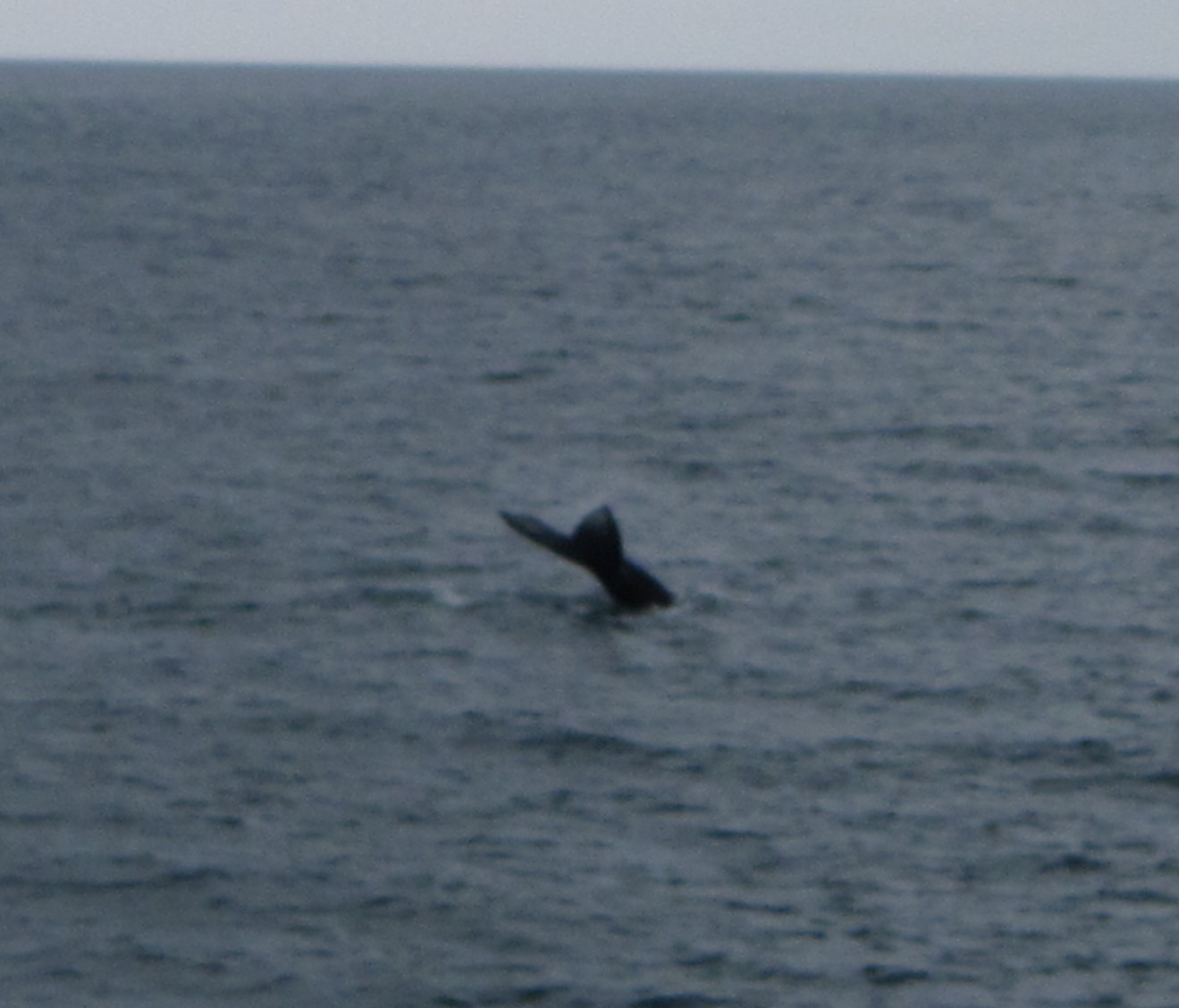
I sighted the whale near the ship and as the ship slowed to a stop it dove, reappearing on the other side. There it spouted several times before going deep as its tail appeared. The ranger said it would be too long to wait and so we started to leave, when suddenly the whale broached and then started to slap its tail on the surface of the ocean.
It continued doing this for a long time and we all lost count, before it seemed to tire. It then switched to slapping its pectoral flipper. Again and again it slapped the water as it if were sending an important signal, but no one knew what it was.
It wasn't the first humpback we had seen today, but the fourth, as we had also watched a mother and calf playfully romp in a cove. Another humpback whale had also appeared at a distance and it was like we were seeing whales everywhere we went,(On a sadder note we have seen whale baleen sold on street corners, even here in Seward).
They weren't the first sea mammals of the day as those had been two different pods of Orcas. One was the AB pod which swam through the oil spill of the Exxon Valdez. The ranger on board told us that the pod had never produced a calf since that exposure and it makes you wonder what the future holds for the Gulf of Mexico.
We still weren't done as several pods of Dall Porpoises rode our ships wake. They seemed to love riding the surf of the ship's wake and several rode the bow wave. Its so refreshing to see large mammals at play and so we kept a watchful eye on the sea.
We stopped at a haul out for Stellar Sea Lions and they all lazed on the rocks. Another island and this was an unofficial rookery, it it had been an official rookery we could not approach within three miles of the resting endangered mammals.
We still weren't done as we stopped at a tidewater glacier and there three harbor seals rested on the ice. Sea otters ran across the ice fall and glaucous and herring gulls rested after feeding on the herrings that congregated in the area.
What a day! It was filled with too many images of ice, mammals, rock, and birds. Those are other parts of the story and I simply don't have room here to crowd them all in. The Orcas alone would have been worth the cost of the cruise and we had seen so much more. Clear skies
It continued doing this for a long time and we all lost count, before it seemed to tire. It then switched to slapping its pectoral flipper. Again and again it slapped the water as it if were sending an important signal, but no one knew what it was.
It wasn't the first humpback we had seen today, but the fourth, as we had also watched a mother and calf playfully romp in a cove. Another humpback whale had also appeared at a distance and it was like we were seeing whales everywhere we went,(On a sadder note we have seen whale baleen sold on street corners, even here in Seward).
They weren't the first sea mammals of the day as those had been two different pods of Orcas. One was the AB pod which swam through the oil spill of the Exxon Valdez. The ranger on board told us that the pod had never produced a calf since that exposure and it makes you wonder what the future holds for the Gulf of Mexico.
We still weren't done as several pods of Dall Porpoises rode our ships wake. They seemed to love riding the surf of the ship's wake and several rode the bow wave. Its so refreshing to see large mammals at play and so we kept a watchful eye on the sea.
We stopped at a haul out for Stellar Sea Lions and they all lazed on the rocks. Another island and this was an unofficial rookery, it it had been an official rookery we could not approach within three miles of the resting endangered mammals.
We still weren't done as we stopped at a tidewater glacier and there three harbor seals rested on the ice. Sea otters ran across the ice fall and glaucous and herring gulls rested after feeding on the herrings that congregated in the area.
What a day! It was filled with too many images of ice, mammals, rock, and birds. Those are other parts of the story and I simply don't have room here to crowd them all in. The Orcas alone would have been worth the cost of the cruise and we had seen so much more. Clear skies
Subscribe to:
Posts (Atom)