Thursday, August 25, 2016

Floating Wilsons Creek, at Brown Mountain Beach Resort in Western North Carolina

I now know what a pinball feels like, while its bouncing from bumper to bumper without any control. That’s because I was a human pinball as I rode the inner tube down Wilsons Creek while bouncing off the rocks and boulders being propelled from chute to chute and rapid to plunge pool.
Renita and I had left Star Valley, driven to Salt Lake City, and flown to Charlotte, North Carolina for our daughter’s wedding. It was a destination wedding at a resort, located between Morgenton and Lenoir.
The soon to be married couple had chosen the location as it had all the requisites. These included waterfalls, trees, and it was an in between place where all the families and friends could meet.
It was the day before the wedding and a group of seventeen daredevil individuals carried each one’s tube down the tree shrouded path to the water’s edge. Pushing off required all to dodge some low rocks and to learn not to allow ones behind to stick through the bottom of the tube. This was because the rocks and bottom were a way of getting hung up and it hurt when you hit a rock!
Quickly the group became separated as the myriad channels moved at different speeds. Compounding this, was the frequent stops as everyone bounced off rocks and learned, I already said this, to not let one’s bottom stick through the bottom of the tube as you got hung up.
Even though many of the floaters were good swimmers, it also became quickly apparent that one could not control the tube. Trying to change direction with one’s arms and legs by paddling and kicking had almost no effect. So when the minister, Mona, became stuck in the middle of a rapids almost everyone sped by all out of control and unable to help.
Luckily the bride, knowing that the minister was an important component of the wedding, was able to get near her and talk her through the white water and large boulders, (Jen had earlier told us she would allow nothing to stop her wedding).
Meanwhile I heard the water roaring and realized I was near a waterfall/chute that I really didn’t want to go down. Attempting to stop, the current sped up and, like everyone else, I had no choice but to go along for the ride!
Surviving the ordeal, it was really fun after all , I was able to stop and take images of others as they screamed, shouted, and laughed, as the water took them for their own bobsled ride.
The rest of the way to the resort was more of the same. I was never in control and like the proverbial pinball bounced from rock to rock as they acted like bumpers and flippers spinning me down the stream.
Finally, I reached the old broken dam surviving one more rapids and catching up with the rest of the group in a large slow pool. A rope hung from the far side and a large group of thrill seekers headed over to it but I decided that I was too tired and paddled to the beach.

Everyone had fun and some of the group rode the rapids the day of the wedding. However, I was in the wedding party and so I watched with envy as I dressed in my finest and waited for pictures. Clear skies

Friday, August 12, 2016

Perseid Meteor Shower August 12th, 2016, Thayne, Star Valley, Wyoming

There are meteor showers and there are meteor showers. Often the term shower is used loosely and its really a meteor drizzle. Several times a year there are true showers, like the Perseid's, and every thirty three years a meteor storm occurs. That one is named the Leonids and happens in November.
The highest meteor count I ever made was in the Lenoid Shower in 1999. I held a star party and my students and I counted 347 falling stars per hour.
This morning was the peak of the Perseid's and I had no problem waking up in the middle of the  night and going outside to see the shower, (One of the advantages of getting older is the need to get up in the middle of the night).
 Settling in to our new lawn chairs, and wrapped up in a blanket, I first looked at the Little Dipper. All the stars were visible and so I knew I had excellent viewing conditions. I knew that would be the case as we live at six thousand feet, with no light pollution.
The Milky Way was overhead in all its glory and Perseus was just below my zenith. Noting the time I began to count the falling stars and from 2:36-2:57 am MDS time I counted 26 falling stars. That turns into an hourly rate of seventy four falling stars per hour.
Going back inside I woke up Renita, (she had actually asked me to), and returning outside we counted 32 falling stars from 3:03--:21 am. That calculates into 106 falling stars per hour and that is one of the best meteor counts I have ever had for the Perseids!
The next seventeen minutes, 3:21-3:38 gave us 30 more meteors with a count about the same, 105 per hour. By this time Renita and I got cold, its cold here in the mountains, and she went back to bed. I stayed outside for another count and saw twenty more in the next fourteen minutes, from 3:38-3:52 a count of 86 per hour.
By this time I was pretty cold so I also went inside to calculate the hourly rates and make some cinnamon rolls. They are never as good as the ones made by my sister Connie, but that's no surprise as she makes the best cinnamon rolls in the world!
All in all it was one of the best meteor shows we have ever seen and definitely the best Perseids! Clear skies


Wednesday, August 3, 2016

Floating the Salt River 2016, from the Swimming Pool to Pallisades

Arriving at the Swimming Pool launch site, we noticed that the rivers level was down from the last time we made this float. Not sure what this would mean we nevertheless pushed off. Quickly we passed the first hurdle, a chute through a man made rock pile. It was one of many that allows the water to be diverted for irrigation.
The water was crystal clear and while the river was swift there was nothing challenging for the first half of the float. This allowed us to watch for wildlife and especially to look for rising trout. There were fish everywhere but we didn't bring our fly rods as this float was mainly a quick run of an unknown distance.
We passed great blue herons and mergansers, along with the occasional duck and osprey. The first real rapids approached and we tried to enter a chute nose first but Val hung up and was swung backwards. I stopped downstream and watched her, Smirking a bit I told her that it was easier going down the river forwards and you can imagine what happened next. Yup, I hit a shallow spot, almost flipped my kayak, and got hung up, before going backwards through the rapids.
Paying more attention to the shallow spots and rapids, easy class two, we both had fun as we entered chute after chute and easily avoided any snags. In one passage we missed spotting a large submerged rock and both took a glancing blow on our starboard sides.
Twice the rapids were large enough that we were splashed in the standing waves and took water over the sides. Not a lot however and while we were wet there wasn't enough in our yaks to present any problem and require us to land and empty the water.
Passing the first bridge we saw that the small covered bridge had been adorned with flowers. Diversions came and went and we had a few tricky runs but nothing that caused any problems. Too soon we passed a second bridge and then the McCoy bridge. The water had been so fast that it had only taken us one hour and twenty minutes!
The river changed quite a bit and after passing one short rapids the stream spread out a bit. The bottom dramatically changed it's characteristics with lots of flat white clay/mud and we stopped seeing any rising fish.
It only took twenty minutes to see George at our take out point. He helped us get unstuck in a shallow spot and didn't have anything good to say about the fishing. He had lost four flies and hadn't had a bite. It was the first time he has been skunked here and he seemed to take offense at the lack of the fishes cooperation.
We both agreed that the float had been one of the best floats we had ever had! It was a fun and quick float that only took one hour and forty minutes, but that because we hadn't stopped to fish. Now if we could just talk Renita into learning how to bof, (a method of using the fast current near large rocks) rocks and run the easy waves, (fat chance). Clear skies

Wednesday, July 27, 2016

Driving Through the Burned Area along 189/191, The Cliff Creek Fire

We have been closely watching the Cliff Creek Fire. It’s a fire that has grown to almost fifteen thousand aces, which is about twenty-five square miles of burned area. The fire is east of us and poses no threat but the fire area is not far from where our son and his wife live. They also have not been in danger and the smoke hasn’t been bad there but worrying goes with being parents.
So when the highway reopened we decided to drive through the burned areas. On the way we were treated to the sight of a nanny mountain goat and her kid but they disappeared into trees before we could take any images. As we approached Hoback Junction, the smoke increased and we could see it was thicker as you went traveled along the Hoback River.
Heading up the Hoback Valley we drove past a camp of firefighters. It was early and they were gathered in circles, engaged in a morning meeting/gathering. Periodically fire trucks were parked at strategic places as all eyes were concentrated on monitoring the fire and protecting any structures.
We didn’t encounter any burned areas until we were well up the canyon and then we passed through typical fire patterns. Forest fires don’t burn everything and so interspersed with burned ground, and areas where the fire crowned out were areas of green where the fire bypassed small groups of trees.
There were areas where the fire had only left pillars of tree trunks and areas where even these had burned, the hottest areas of fire. While we didn’t see any of these I did take classes on fire ecology and I had actually seen where large sheets of granite had exploded off of massive outcrops. Such an explosion is caused when the intense heat turns trapped water into steam. You literally see sheets of rock laying on top of ash.
Nearing the town of Bondurant we saw where the firemen/women had made stands and saved buildings along the river valley. Many were Federal Hotshot fire crews from all over the West.  Just south of the town a heliport had been set up where helicopters were based while fighting the fire.
Driving by them we spotted a huge badger poking his nose out of the ditch but again we couldn’t get any images before he moved back into the sagebrush. His claws were huge and reminded me of ones we had seen on grizzly bears in Alaska, seriously!
We did see some of the fire itself in burning areas away from the road. You could also see a line of current fires burning towards the Gros Ventre, (pronounced grow vont), Mountains. The plan now is to let the fire burn itself out, (when the snows fall), and to contain the fire by back burning. That is a process where fires are deliberately set, when the winds are favorable, to take fuel away the active fire.
As I look at the burned areas I think of how the newly burned area will bloom with life. Such burned areas are a far cry from the sterile forest floor under a mature forest canopy. This area was well past maturity and many of the trees had died from the pine beetle infestation. The same thing happened when Yellowstone burned in the fires of 1988 and the herds of grazers increased, (elk, deer and buffalo).

Clear skies

Wednesday, July 20, 2016

A Day with Friends at Greys Lake Refuge

Bob and Nancy visited us last week and of course I told them of all the fish we were catching. We spent a day on the Little Grey and then a day on Salt Creek and you can probably figure out what happened. The water had dropped at both streams and the fishing was nonexistent. Still we had nice picnics and of course the scenery was beautiful, but no fish. So on their last day we decided to take a break from fishing and go birding at the Greys Lake Refuge. Surely the birds would cooperate.
Arriving at the refuge headquarters Renita first spotted a family of sandhill cranes. The day was already a success! A little further down the road Nancy spotted a pair really close to the road and so we tried to take some images as they walked through the thick grass and reeds.
Further on we stopped to watch a turkey vulture sitting on a fence post. A flock of mountain bluebirds put in an appearance and the day became a day of relaxing bird watching. Stopping at some open water we pointed out yellowheaded blackbirds and to add to the stop, three white faced ibis flew overhead. The breeding colored iridescence had faded from their wings but no matter it was a nice trio of close flying birds.
We really spotted quite a few sandhills, many more then we saw during our last trip. Stopping along the road we showed them the volcanic rock that dominates the landscape. Some was hardened pyroclastic breccia which told of nuee-ardente, Its  the most dangerous type of lava that flows down the volcano's sides at several hundred miles per hour.

In places the basaltic lava flows were full of vesicules, bubbles that formed when the molten lava out gassed much like a shaken can of pop. However the lava had cooled so quickly that the bubbles were trapped, forever frozen in the stone.
Leaving the refuge we returned along Tin Cup Creek and found a nice place to stop for a picnic. As we ate a sheep herder drove his flock on the road near us and in the flock was a single black lamb. Renita and Nancy ended up taking way to many images of the sheep drive, but that's what the new cameras are for, taking lots of very inexpensive images.
So we had a nice day of birding and after the necessary hugs and goodbyes waved them adieu promising to see them again, down the road, Of course we went fishing the next day and Renita and I both caught beautiful cutthroats, but that's the way fishing goes. Clear skies.

Tuesday, July 12, 2016

We celebrated the fourth by walking outside and watching the fireworks. There was really nothing nearby but looking across the Lower Valley we could see occasional bursts. There seemed to be two main areas, one was near Thayne and the other along the Salt River. No fireworks were allowed in the resort as the threat of fire is always present.
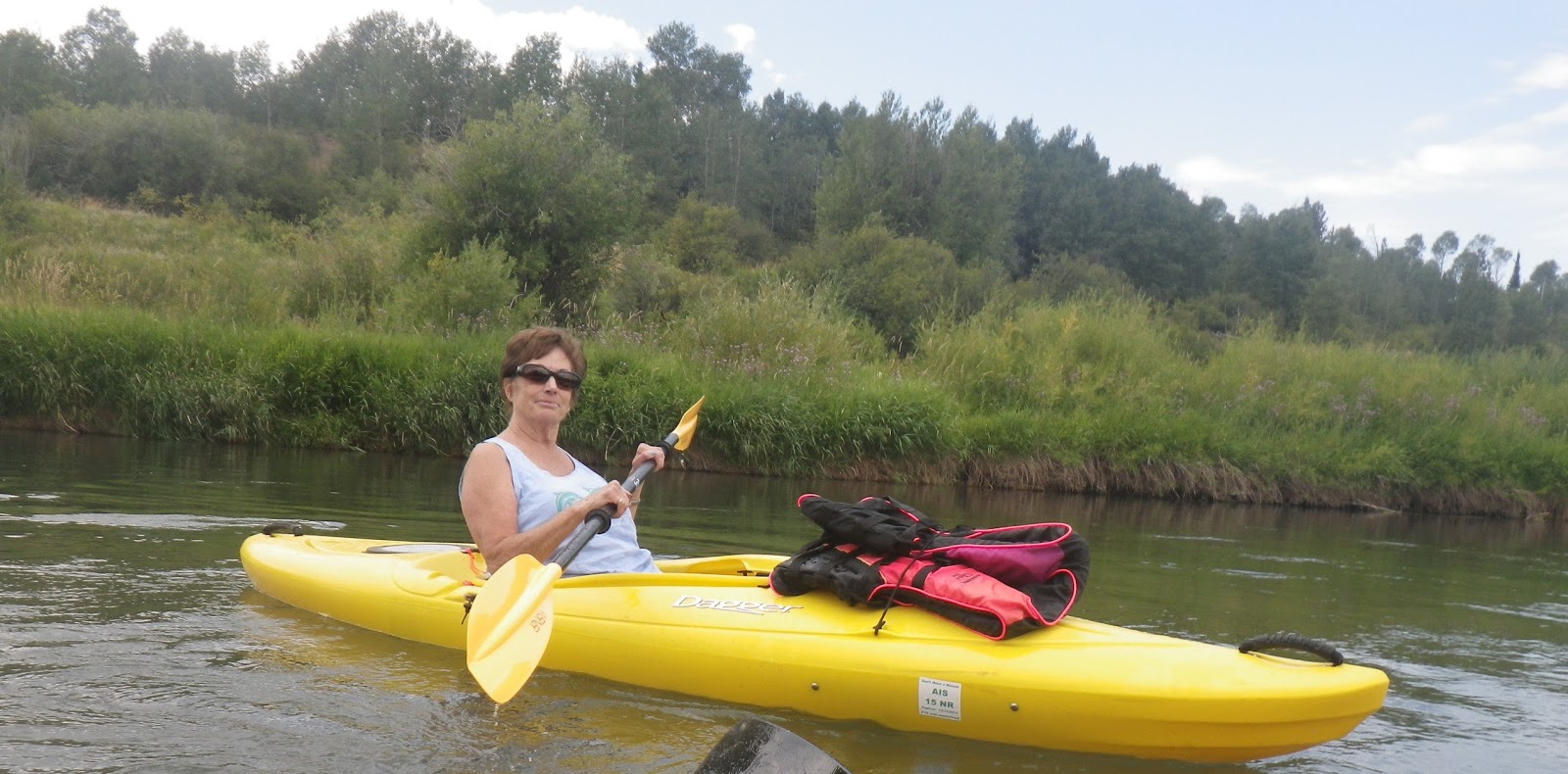
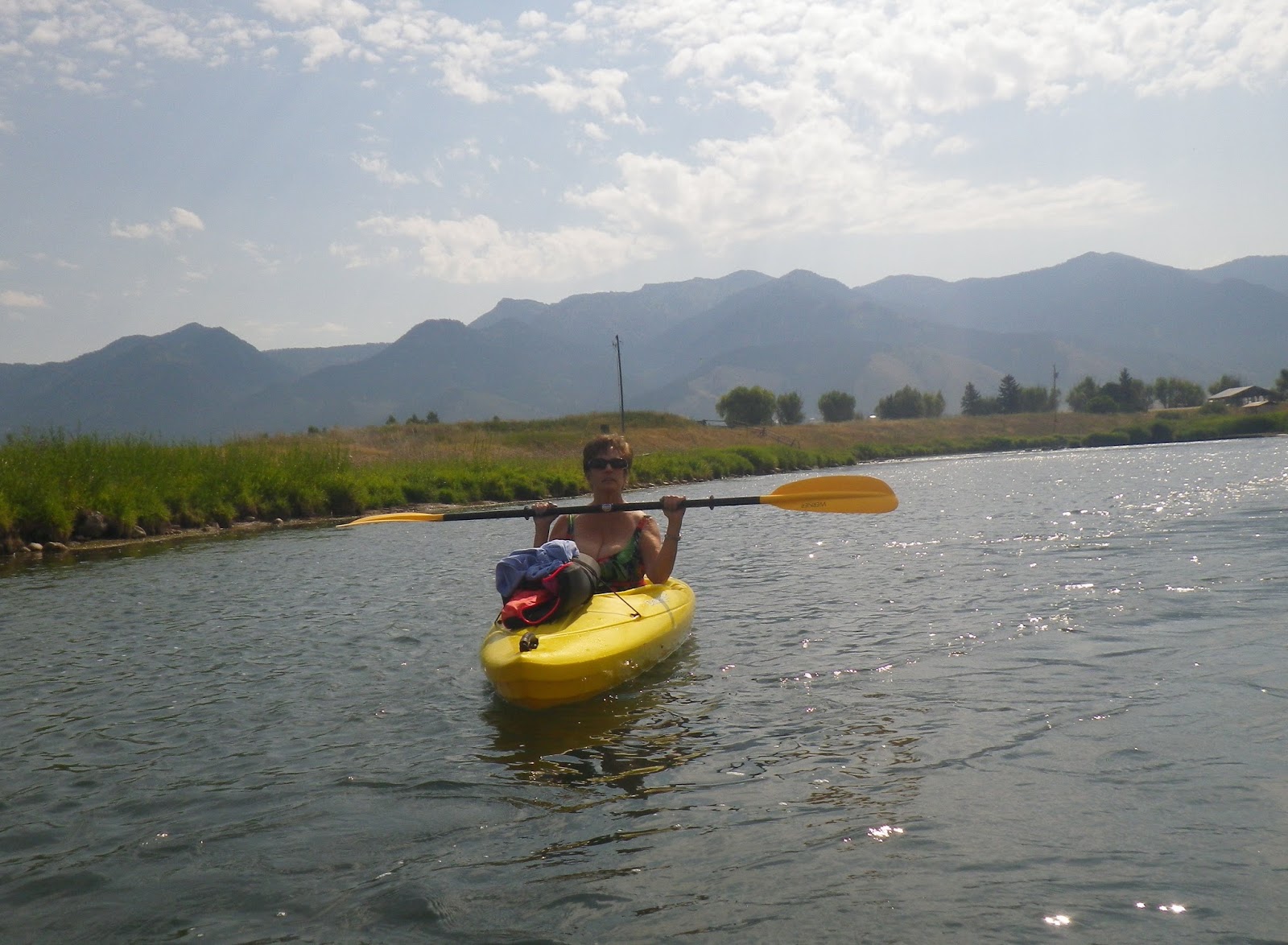
Two days later found us floating the Salt River, from the Creamery to a landing point called the Swimming Pool. George, Val’s husband, had agreed to take the truck to the take out point and so we pushed off into a fast current. In no time at all Val was around the first meander and Renita followed closely behind her.
I could tell Renita has learned a lot about floating the river as she chose the quieter channel, easily avoiding the one hazard. Val had hit the low branches one time and dumped her kayak but both women easily passed the test.
Meanwhile I was attempting to fish the fast moving stream using two nymphs with a small split shot and a strike indicator. I had tied on the new flies, a pheasant hair nymph and a very small nymph called an emerger. On the first cast I watched the indicator move sideways and was fast onto a really nice fish.
As I fought the fish the current kept sweeping my kayak downstream and between the fish pulling in one direction and the yak in another the hook pulled out. Another cast and the same result before I caught a small mountain whitefish.
Around the next bend another good looking spot presented itself and on the first cast I snagged and broke off both flies. Fifteen minutes later I caught up with the two speeding girls, they had pulled over and waited as I had retied two new flies.
Two more casts and I broke off the new flies and so I switched to a dry, a purple haze with a small emerger as a dropper. Nothing took my flies even though I made some casts to rising fish. Meanwhile the current was taking me rapidly sideways and I soon swept into a submerged log. I was lucky I didn’t dump the boat!
Snagging the flies I lost two more and then high centered on another snag. Deciding this simply wasn’t working, I resigned myself to enjoying the float and placed my fly rod aside for the rest of the float. After about two hours we reached George at the first take out point and after a brief chat we pushed off to finish the float.
The river was moving so fast that we reached the Swimming Pool in about twenty minutes, (it has taken us forty minutes on previous floats, because we seldom are in a hurry). It had been a nice day and a nice float. It had also shown the promise of the new flies I had purchased along with the folly of trying to fish while floating a fast moving river.

On the way home we talked of the great float and the promise of more floats to come. I also decided I need a shorter kayak as my twelve footer is just to long for the fast current and sharp bends of the Salt River. Clear skies

Saturday, July 9, 2016

Fine Spotted Snake River Cuththroats

I cast the royal wolf to an eddy . The snow had melted and the water had finally cleared. The dry fly floated past the eddy and almost reached the end of the run when I saw the fish rise up and take my offering. Setting the hook I saw the flash and knew that I had another fish on!
It had been a typical June with high and muddy waters and this was only the second time out. The Greys River was our first choice but as soon as we saw the milky water we knew we had to try a smaller stream with clearer water.
We had already fished Salt Creek and Val and George had also fished Fall Creek. Salt had been a great bite on nymphs and they had told us that Fall Creek was full of small but fun cuts. Now we all had put on our favorite fly, George of course was using a nymph and Val had selected a lime trude.
They had headed upstream, while I headed down and I knew that they had to be on fish.
I caught the small but feisty fish and using the forceps unhooked and released it back into its home. It seems a shame to kill such a beautiful wild and native fish, (although I love eating fish), and making another cast to the same run another cut rose to my offering. I ended up catching and releasing four fish from the same stretch, before heading further down the river.
Picking up a fish hear and there I noticed some movement on the other bank and stood still as a raccoon walked along the shore hoping to find something good for lunch. I was sure it would love a fresh trout but there was no way I would offer it one as I refuse to feed wild animals, ( a fed bear is a dead bear and it just doesn't refer to bears).
Heading down the canyon the walls closed in and I realized I would have to scramble quite a ways before I could cross the stream and make the steep climb to the road. Of course I rolled my ankle when I forded the creek but it wasn't as bad as iI feared and so I labored up the series of switchbacks until I stood on top.
Chastising myself for putting myself in such a predicament I still had caught and released ten fish and so I felt pretty good as I hiked back to the car looking for my friends. Reaching George I saw him in the act of releasing a fish and he told of how the fish had been inhaling his nymphs..
A little further I tried my favorite hole and four more cuts chewed up my fly. Seeing Val I watched as she retied a new fly and she told me of fish after fish. She said that the fish had destroyed her trude and how she had lost track of the number of fish she had caught!
Passing round her, I continued to catch fish on my same royal wolf until I too lost count somewhere in the twenties. For every fish I did succeed in landing and releasing I had lost or missed three more. It was one of those days where nothing seemed to go wrong. I tired to think of other fishing trips and the only one that bested this day was the opening day on the Yellowstone River.
That was way back in 1974, when Renita and I had retraced my summer geology field camp experiences from the year before. At that time I was still in school not knowing that the trip to Wyoming was a precursor to us moving there.
Meeting back at the car we talked of the great day! We had caught and successfully released over seventy five fish. Eating our lunch we decided to call it a day as we were all tired from climbing the steep banks. Whats really funny about it all is that we had not seen another fisherman! Clear skies